A guest walks into a restaurant alone or with a partner. Orders the tasting menu. Asks the sommelier three very specific questions about the wine pairing. Requests the in-room dining menu later that night, even though they already ate. Checks the turndown timing. Comments, almost too casually, on the thread count of the sheets.
By the second day, half the leadership team has the same thought. This is the auditor.
Every general manager who has run a brand-affiliated luxury property knows this scene. It plays out quietly, almost ritually, a few times a year and it is worth talking about honestly, because the intention behind quality audits is good and the way many hotels have learned to handle them has started to work against that intention.
Why the audit exists in the first place
Brands sign agreements with third-party quality assurance firms for a simple reason. A general manager cannot see their own hotel the way a guest sees it. Neither can a regional director, however many site visits they make. Staff recognise leadership. Routines change when someone senior walks the floor. The only honest read on service is the one taken when nobody on property knows they are being watched.
A trained mystery shopper experiences the property exactly as a paying guest would, recording observations on service quality, employee interactions and overall guest satisfaction throughout the stay. Leading frameworks like LQA go further still, scoring not just whether a service step happened, but how the guest felt during it on a scale that runs from neglected and frustrated through to genuinely cared for. That is a meaningful, well-designed tool. It is one of the few mechanisms a brand has to know, with any honesty, whether a 100+ room hotel on the other side of the world is actually delivering what the brand promises.
None of what follows is an argument against that. It is an argument for using it properly.
Where the intention quietly breaks down
Most hotel teams will tell you, off the record, that the auditor’s identity is rarely a complete mystery for long. A reservation pattern that does not match a typical guest profile. A booking made directly through a quality assurance firm’s known channel. A single traveller dining alone, asking unusually structured questions, sampling services a normal guest would skip. None of this requires detective work. Experienced operations teams pick up on it within hours, sometimes before arrival.
And once they do, something predictable happens. The best server in the restaurant is quietly assigned to that table. The most senior housekeeper turns that room personally. The GM finds a reason to walk past at exactly the right moment. The guest who actually paid full rate at the next table waits a little longer for their water to be refilled, because attention has been redirected.
The audit score comes back excellent. The hotel celebrates. And the gap between what was scored and what most guests actually experience grows a little wider, unnoticed.
This is not a story about dishonest hoteliers. It is a story about an incentive structure that, without anyone intending it, has taught very good teams to optimise for the test instead of the thing the test was built to measure.
A score that is too high should raise the same question as a score that is too low
Most properties only ever look downward at their audit score. Below a certain number, there is concern, a corrective plan, sometimes consequences for department heads. Above a certain number, there is celebration, bonuses, a line in next year’s performance review.
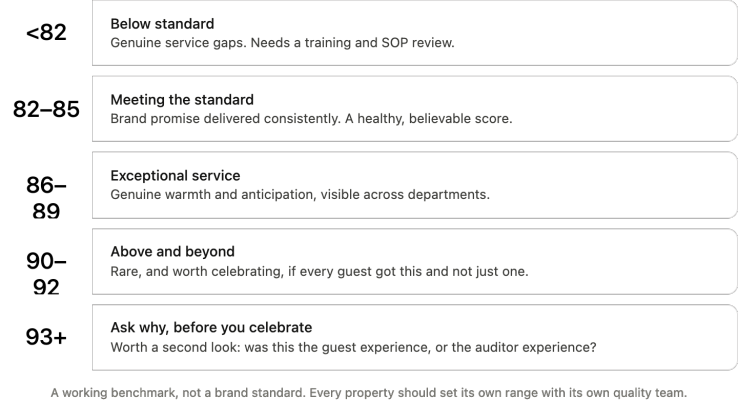
What gets far less attention is the upper end of the scale. A consistent run of scores in the high nineties from a large, complex, multi-department hotel is statistically unusual. Service this good, every single time, across housekeeping, F&B, front office, and spa, delivered by hundreds of individual human interactions a day is rare in any operation, anywhere in the world. When it shows up reliably, the more useful question is not “how do we celebrate this,” but “was this the guest experience, or the auditor experience.”
A score that is too high to be believable deserves exactly the same scrutiny as a score that is too low to be acceptable. Below is a working benchmark not a brand standard, every property should calibrate its own with its quality team but a useful starting frame for how leadership might read the number, rather than just react to it.
What the audit is actually for
An audit’s only real job is to find the gap between the service a brand promises and the service a guest is actually receiving. That is the entire purpose. It is not a performance review. It is not a bonus trigger. It is not a referendum on whether a department head keeps their job.
The healthiest way for a general manager to treat an audit is the same way they would treat conducting it themselves. Walk the report the way you would walk the floor looking for where the standard slipped, not for who to blame. A missed step at check-in is useful information about a training gap. It is not evidence of a bad employee. The moment a team’s growth, bonus, or job security becomes tightly bound to a single audit score, the team’s energy quietly shifts from delivering good service to managing the appearance of good service. That shift is rational, human, and almost impossible to reverse once it sets in.
It also creates a second, quieter problem. Properties that genuinely strive the ones training hard, coaching honestly, improving steadily end up compared against properties that have simply gotten skilled at spotting the auditor. On paper, both look equally excellent. In practice, only one of them is.
The deeper issue: training is often a department of one
Leadership training is the single highest training priority cited by HR and L&D professionals across the hospitality industry, and yet in a great many hotels, learning and development is still one person, sometimes shared across properties, buried inside a talent and culture department otherwise occupied with recruitment paperwork and policy administration.
That is the structural root of the problem this article is really about. If a hotel does not have the bench strength to train consistently to standard, the daily SOP checks fall to already-stretched supervisors, who tick a weekly box rather than coach a genuine behaviour. The gap between standard and delivery widens quietly through the year. Then an audit visit arrives, the gap becomes visible all at once, and the fastest fix available in that moment is not training it is identifying the auditor and managing the next 48 hours carefully.
Genuine investment in leadership and operational training builds an internal talent pipeline and reduces dependency on reactive, last-minute fixes a one-person L&D function, however capable, cannot carry that weight for lets say a 200-room property with five outlets and three shifts. This is not a resourcing nice-to-have. It is the difference between a hotel that is audit-ready every single day, and one that is audit-ready for the three days a year someone might be watching.
What above-property leadership can do differently
Regional and brand leadership set the tone that property teams respond to, often without realising it.
- Read the audit report with the property team, not at them. A conversation about where the gap is and why builds more lasting change than a number reported up the chain.
- Decouple compensation and career growth from any single score. Tie reward instead to sustained improvement across several audits and across the guest feedback the property collects every single day.
- Resource learning and development properly. One executive supported by real trainers per division, not one person carrying an entire property’s standards alone.
- When hiring or promoting supervisors and department heads, weigh their ability to coach and train a team as heavily as their technical or commercial skill. A department head who can train well builds an audit-ready team without ever knowing an auditor is coming.
- And be honest about scores that look too perfect. Asking “why was this score so high” protects the integrity of the whole programme as much as asking why a score was low.
Choosing the audit firm deserves the same scrutiny
Brands choose quality assurance partners on reputation and history, which is reasonable. But the name on the contract is only as good as the individual auditors that firm sends. A few questions are worth asking before signing, and worth revisiting periodically after.
- Are the auditors themselves experienced in hotel operations, not just trained on a checklist does their background give them the judgement to tell genuine warmth from rehearsed service?
- Is the same small pool of auditors circulating across a brand’s hotels for years, becoming recognisable across an entire portfolio rather than just one property?
- Does any individual auditor’s scoring pattern sit consistently above the portfolio average, regardless of which property they visit? A pattern like that is worth a conversation with the firm, not an assumption of fraud, but a genuine check on calibration.
- Is there a rotation policy that genuinely refreshes which auditor visits which hotel, rather than the same few names becoming familiar faces on property over time?
The point of all of this
None of this is about catching anyone out. Every hotel team that has ever quietly worked out who the auditor is did so because they care about the score, which means they care about the brand, which is, underneath it, a good instinct pointed in the wrong direction.
The fix is not a stricter audit. It is treating the audit the way it was designed to be treated from the start a mirror, not a test. Something a property uses to see itself honestly, the way a general manager would want to see it if they were checking in anonymously themselves. Find the gap. Train to close it. Do it again next quarter regardless of who is watching.
A hotel that is ready for an audit every single day, without knowing one is coming, is not a hotel that has learned to spot a mystery guest. It is a hotel that has stopped needing to.
Binny Sebastian is a luxury hospitality executive with over 26 years of international experience across Raffles, Taj, Six Senses, Alila (Hyatt), Marriott Autograph Collection and Oberoi.
#HospitalityIndustry #HotelManagement #LuxuryHospitality #GuestExperience #QualityAssurance #HospitalityLeadership #LearningAndDevelopment #ServiceExcellence #HotelOperations #BrandStandards
Binny Sebastian Boutique Hotels Emotional Intelligence Guest Experience Strategy Hiring Hospitality Leadership Hospitality Talent Hospitality Trends India Hotel Brands Hotel General Manager Hotel Owners & Investors Hotel Pre Opening Human Resources Luxury Brand Differentiation Luxury Hospitality Luxury Hotel General Manager Luxury Hotel Positioning Organisational development Organisational politics Productivity Revenue Strategy Skills Sustainability Talent Management TransformationalLeadership Ultra-High-Net-Worth Travel UltraLuxury Wellness WellnessHospitality