There is a photograph I keep in my mind from early in my career. I am standing on a dock in the British Virgin Islands late in the evening, watching the sun go down, waiting for a supply boat that is two hours late. A guest, a quiet man who had barely spoken all week walked down and stood beside me. We did not say much. Just watched the light change together. He left next afternoon and sent a handwritten note a week later. He said that evening at the dock was the best moment of his holiday.
No technology captured it. No KPI measured it. It cost nothing. And it was irreplaceable.
I have been thinking about that moment a lot recently because I am not sure the industry is still hiring for the kind of leader who knows what to do with it.
McKinsey’s 2024 research on luxury hotel leadership found that the primary reason guests choose a travel brand in the future is not value, quality, or convenience it is “positive past experiences with the brand.” Culture, they found, is the differentiating factor. And culture begins with leadership.
Two kinds of luxury. One label.
Luxury hospitality has always contained two distinct philosophies and they have quietly been competing with each other for decades.
The first is what I would call transformational luxury. Smaller inventories. Open-air dining. Mindful eating, long before it was a marketing category, wellness that was rooted in place, culture and genuine restoration rather than a spa menu. A general manager who knew your name, your habits and why you came. Properties where the guest experience was inseparable from the destination. Where Aman’s Adrian Zecha could show the world in the 1980s that understated design and authentic cultural immersion could rival the most opulent traditional hotels. Where Sonu Shivdasani built Six Senses around a “barefoot luxury” philosophy that placed sustainability, wellbeing and local sensitivity at the centre, not as brand claims, but as operating principles.
The second is what I would call transactional luxury. Larger inventories. Function space. Loyalty points. Revenue per available room. A general manager measured primarily on EBITDA, channel mix and cost per occupied room. Operationally sophisticated. Commercially disciplined and genuinely valuable because the revenue generated by these properties funds the industry’s growth, its training infrastructure and the careers of thousands of hospitality professionals worldwide.
Neither philosophy is wrong. Both have a place. The industry needs both.
The problem is that we are now hiring for the second while searching for the first and the two are not interchangeable.
What the job descriptions are asking for
I have spent recent months reviewing GM role specifications across properties that define themselves as ultra-luxury resorts, heritage properties, destination wellness retreats, Properties that are explicitly positioning themselves around cultural immersion, personalised service, and transformational guest experience.
The criteria that appear most consistently: multi-department operational management of large properties, 200+ key experience, PMS system proficiency, loyalty programme oversight, channel management, high-volume F&B revenue targets.
These are all legitimate requirements. They are also, almost without exception, the criteria that produce general managers who are exceptionally skilled at running a large transactional operation and not necessarily the ones who will sit on a dock at sunrise or sunset with a quiet guest and understand that the best thing they can do in that moment is simply be present.
This is not a criticism of recruiters. Hospitality recruitment is genuinely difficult, particularly at the GM level, where the roles are few and the variables are many. But there is a pattern that is worth naming: when a property describes itself as transformational but specifies criteria drawn from transactional operations, it creates a confusion that affects the entire talent pipeline because the candidates who match those criteria will build the team, culture, and operational model that reflects their experience. And over time, the property will become what it hired for, not what it aspired to be.
“If luxury hospitality organisations continue to educate, hire and promote leaders primarily for operational control rather than emotional intelligence, they will become more efficient yet increasingly forgettable.” — Hotelier & Hospitality Design, May 2026, citing Bain & Company and McKinsey research
The supply problem no one is talking about
Here is what concerns me most about the long term.
Transformational luxury general managers are not manufactured at scale. They are formed over decades through decades of leading in remote destinations, in properties where the guest-to-staff ratio is 1:3, in environments where a sunset conversation matters as much as a cost-per-cover ratio. They come from Aman, from Six Senses, from independent island resorts where the GM’s most important skill was not revenue management but the ability to make a person feel genuinely seen.
That pipeline takes a generation to build and right now, the hiring requirements of the industry are incentivising the next generation of hospitality talent to move toward transactional operations because that is where the broadly applicable experience criteria are being written.
If the candidate pool for transformational luxury properties continues to be shaped primarily by transactional criteria, we will arrive soon where the properties that need transformational leaders cannot find them. Not because those leaders do not exist, but because the system selected them out of the pipeline over a decade earlier.
What clear hiring looks like
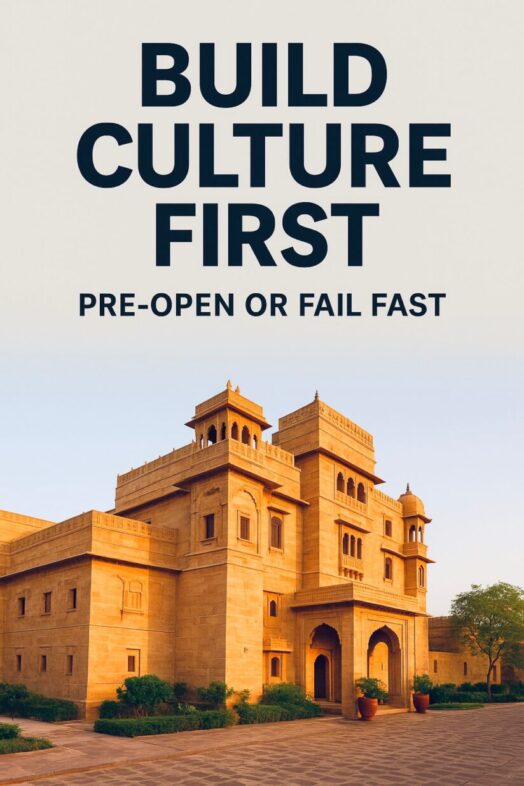
I want to be careful here, because I am not arguing that transformational luxury should ignore financial performance or operational discipline. The two are not opposites and anyone who tells you that great guest experience and strong EBITDA are in tension has not done the work of building both simultaneously. At Raffles Jaipur, I delivered two digit % positive EBITDA within six months of opening and earned Two MICHELIN Keys in Year 1. At Taj Meghauli Serai, I grew revenue three digit % while raising guest NPS from 89 to 95. The guest experience and the commercial outcome were the same project expressed differently.
But commercial discipline in a transformational property looks different from commercial discipline in a transactional one. It shows up in rate strategy and ancillary revenue design, in experiences people are willing to pay £8,000 for because they are genuinely irreplaceable, not in occupancy-chasing and last-minute OTA discounts. The skills required to build that kind of commercial model are rooted in hospitality philosophy, not hotel operations management.
So the question I would ask decision-makers and hiring committees to sit with, is this: when you write the criteria for your next general manager, are you describing the leader your property needs or the leader your recruitment process is most comfortable evaluating?
Transformational properties might consider asking:
- Has this candidate led in an environment where the guest-to-staff ratio required genuine personalisation, not just service standards compliance?
- Does their background include time in destinations where the property was the experience not just the accommodation?
- Can they build a commercial model around premium, experience-led revenue rather than volume and yield management?
- Have they built teams that stay not because the compensation is above-market, but because the culture is worth belonging to?
A thought for the leaders themselves
If you are a general manager who has built your career in transformational properties and you are finding that the current hiring landscape does not seem to recognise your experience, I want to say something directly: your background is not a gap. It is a discipline. The properties that need you are the ones that cannot afford to hire someone who doesn’t understand the difference between a guest who leaves satisfied and a guest who leaves changed.
The industry’s hiring lens may take time to readjust but the demand from guests particularly high-net-worth travellers who are increasingly allocating spending toward immersive experiences that reflect their identity and values, as McKinsey and Bain have consistently found is moving in your direction, not away from it.
The supply problem is real. But it is also an opportunity for the properties and hiring teams who recognise it first.
Binny Sebastian Boutique Hotels Emotional Intelligence Guest Experience Strategy Hiring Hospitality Leadership Hospitality Talent Hospitality Trends India Hotel Brands Hotel General Manager Hotel Owners & Investors Hotel Pre Opening Human Resources Luxury Brand Differentiation Luxury Hospitality Luxury Hotel General Manager Luxury Hotel Positioning Organisational development Organisational politics Productivity Revenue Strategy Skills Sustainability Talent Management TransformationalLeadership Ultra-High-Net-Worth Travel UltraLuxury Wellness WellnessHospitality